WHOLE FLAVORS™Natural Flavor Systems
What Processing Removes — Restored.
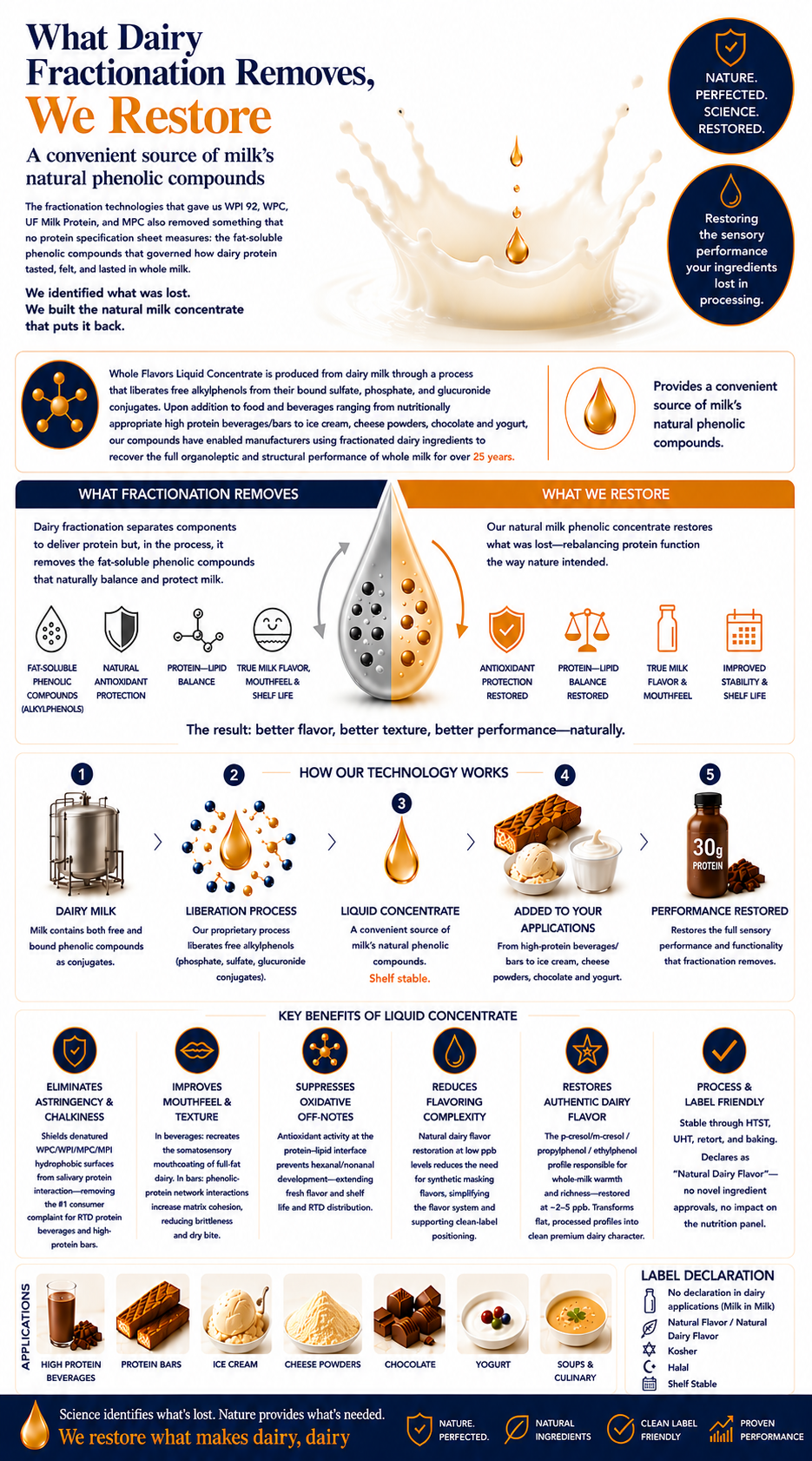
The fractionation technologies that gave us WPI 92, WPC, UF Milk Protein, and MPC also removed something that no protein specification sheet measures: the fat-soluble phenolic compounds that governed how dairy protein tasted, felt, and lasted in whole milk.
We identified what was lost. We built the natural milk concentrate that puts it back.
THE PROBLEM
The Fractionation Paradox
Modern dairy protein manufacturing is a remarkable engineering achievement. Ultrafiltration, microfiltration, and ion exchange allow formulators to isolate protein at extraordinary purity — 90%+, essentially free of fat, lactose, and ash. The nutritional profile is unimpeachable.
The sensory profile is another matter.
Why do the most technically advanced dairy protein ingredients produce the harshest-tasting beverages?
The answer is not the protein. It is what the protein is missing.
In whole milk, proteins coexist in thermodynamic equilibrium with a class of fat-soluble phenolic compounds — alkylphenols — that are produced naturally in the bovine gut from tyrosine and phenylalanine and secreted into milk by the mammary gland's ABCG2/BCRP transporter. At 5 ppb in the fat phase, these compounds perform three simultaneous functions: they partially occupy the hydrophobic surface patches on β-lactoglobulin, moderating the protein's surface chemistry; they contribute the fat-soluble phenolic bottom register that defines authentic dairy flavor; and they act as chain-breaking antioxidants in the milk fat phase.
When cream separation removes the fat, it removes this fraction entirely. Ultrafiltration removes the remaining bound conjugate reservoir. The protein retentate arrives at the formulator at zero alkylphenol content — and with all three of those governing functions absent.
That is the fractionation paradox: the more pure the protein, the more completely stripped of the matrix that made it palatable in its natural form.
THE SCIENCE
What Alkylphenol Depletion Produces — In Order of Commercial Impact
Astringency. Denatured β-lactoglobulin exposes hydrophobic surface patches that interact with salivary proline-rich proteins and mucins, disrupting the oral lubricating film. The result is the drying, chalky, persistent sensation that is the single most common consumer complaint in the protein beverage category — and the primary driver of repeat-purchase failure. In retort-sterilized UF milk protein applications, where denaturation is complete and irreversible, this effect is at its most severe.
Missing dairy character. The fat-soluble phenolic layer — p-cresol, m-cresol, 3-n-propylphenol — contributes the warmth, butteriness, and roundness that consumers identify as authentic dairy. It is not a flavoring note. It is the flavor foundation on which dairy character is built. Its absence produces the flat, processed, one-dimensional protein taste that no conventional flavoring system can fully compensate for.
Thin mouthfeel. Phenolic-protein-fat network interactions at the fat globule interface contribute to the body, mouthcoating, and structural integrity of whole-milk dairy products. Without the phenolic fraction, protein beverages feel thin for their protein content and ice cream melts faster.
Oxidative shelf-life limitation. Residual lipid in WPC and cream additions in UF milk protein RTDs oxidize at the protein-lipid interface without antioxidant protection, producing the cardboard, rancid, and painty off-notes that dominate shelf-life flavor failure.
THE SOLUTION
Whole Flavors Liquid Concentrate
What was removed, restored. At whole-milk equivalent concentrations. Naturally.
Whole Flavors Liquid Concentrate is a proprietary natural flavor system derived entirely from dairy. Through a clean-label fractionation and hydrolysis process, we isolate and standardize the alkylphenol fraction — the same p-cresol, m-cresol, propylphenol, and ethylphenol compounds present in whole milk — and return them to fractionated dairy ingredients at 5–25 ppb in the finished product.
This is not a flavoring approximation. It is not a masking system. It is a precise restoration of the molecular infrastructure that fractionation removed.
The result, across all four axes simultaneously:
— Astringency eliminated. Alkylphenols reoccupy the exposed hydrophobic patches on denatured β-LG, restoring protein surface chemistry to its whole-milk condition and shutting down the salivary interaction that causes astringency. Without reformulation. Without flavor masking.
— Authentic dairy character restored at 5 ppb. The fat-soluble phenolic bottom register returns — warmth, butteriness, roundness — as the foundation of dairy flavor rather than an imitation of it.
— Mouthfeel and structural network improved. Phenolic-protein-fat network interactions restore the body, mouthcoating, and structural integrity that fractionation removed. In ice cream, drip induction time increases versus control. In protein beverages, the product drinks like dairy.
— Oxidative shelf life extended. Chain-breaking antioxidant activity in the fat phase protects residual and formulation lipids against the hexanal and nonanal formation responsible for rancid, cardboard, and stale off-notes through the full commercial distribution window.
THE FORMAT
Whole Flavors Liquid Concentrate is available as a liquid concentrate and as Enhanced Milk Solids — co-dried with milk permeate for direct dry-ingredient incorporation. Both formats are process-stable through HTST, UHT, retort, and baking, and label as Natural Dairy Flavor under GRAS status.
THE COMMITMENT
Clean label. Nutritionally pristine. Sensorially complete.
You built a protein ingredient or protein beverage/bar with an exceptional nutritional profile. We built the concentrate that makes it perform like the dairy it came from.
Whole Flavors does not change your macros, your label architecture, or your process. It restores the one thing the process took out.
WHOLE FLAVORS™ ENHANCED MILK SOLIDS
Non-fat Milk Solids That Performs Like Whole Milk. At a Fraction of the Cost.
Enhanced Milk Solids is milk permeate co-processed with Whole Flavors Liquid Concentrate — restoring the natural alkylphenol fraction to whole-milk equivalent levels in a dry, drop-in ingredient that substitutes for NFDM at more than 50% cost savings.
One ingredient addition. Four axes of dairy function reinstated. No process change.
WHAT IT IS
The Ingredient
Every fractionated dairy ingredient — NFDM, WPC, MPC, milk permeate — is derived from cream-separated skim milk. Cream separation is where the fat goes. It is also where the fat-soluble alkylphenol fraction goes — permanently, completely, and regardless of what further processing follows.
The result is that every dry dairy ingredient in commercial use, regardless of protein content or grade, arrives at the food manufacturer with zero alkylphenol content. They are nutritionally and functionally sound. They are sensorially incomplete.
Enhanced Milk Solids addresses this at the ingredient level — before it reaches the formulator.
Enhanced Milk Solids is produced by concentrating Whole Flavors alkylphenols in milk permeate. The alkylphenols — p-cresol, m-cresol, 3-n-propylphenol, and ethylphenols — dissolve into whatever fat phase is present in the finished application, restoring the natural phenolic architecture of whole milk to a dry dairy ingredient that would otherwise carry none of it.
The result is a powder that behaves, tastes, and structurally performs like a whole-milk-derived dairy solid — at the cost of milk permeate.
THE ECONOMICS
The Cost Case Is as Strong as the Science Case
Milk permeate is the lactose and mineral-rich stream from ultrafiltration — a commodity dairy byproduct priced well below NFDM. Enhanced Milk Solids converts that stream into a high-performance dairy ingredient that outperforms NFDM on flavor, texture, and shelf life while costing substantially less.
At 25% NFDM substitution — the FDA 21 CFR 135.110 compliant starting level for ice cream — the cost savings on the substituted fraction exceed 50%. Customers are running at 50% substitution in novelty frozen dessert applications without sensory compromise.
The net economics are favorable at any substitution level.
THE PERFORMANCE
Four Axes of Dairy Function — Reinstated Simultaneously
The four problems that alkylphenol depletion creates in fractionated dairy ingredients are not independent. They are four expressions of the same removal event. Enhanced Milk Solids restores the alkylphenol fraction at 5 ppb — whole-milk equivalent — and addresses all four simultaneously.
Axis 1 — Flavor Architecture: The Dairy Character Axis
The authentic dairy flavor consumers associate with premium ice cream, quality chocolate milk, and real dairy products is built in layers. The top notes — lactic acid, diacetyl, volatile esters — are water-soluble and survive fractionation. The bottom register — the warm, round, animalic quality that makes dairy taste like dairy rather than a dairy-flavored product — is fat-soluble and does not.
p-Cresol at 2 ppb in the fat phase is at its flavor threshold in dairy systems, contributing the foundational dairy backbone. 3-n-Propylphenol contributes butteriness and cream character at sub-ppb concentrations. m-Cresol provides roundness and depth. Together, at 5 ppb total in the finished product, they restore what fractionation removed — not as discrete detectable notes, but as the foundation on which authentic dairy character stands.
Enhanced Milk Solids restores this register to any application where it is used.
Axis 2 — Surface Chemistry: The Astringency Axis
In whole milk, alkylphenols partially occupy the hydrophobic surface patches on β-lactoglobulin through hydrophobic and hydrogen-bonding interactions. The protein surface is never fully bare. When cream separation removes the alkylphenols, these patches are left exposed — available to interact with salivary proline-rich proteins, precipitate the oral lubricating film, and generate the drying, chalky sensation that limits consumer acceptance of high-protein dairy applications.
Enhanced Milk Solids restores the protein surface moderating function at whole-milk equivalent alkylphenol concentration — eliminating astringency at the source rather than masking its perception. This benefit applies wherever Enhanced Milk Solids is used alongside any whey or casein protein fraction.
Axis 3 — Structural Network: The Texture Axis
In ice cream, the fat globule network governs melt resistance, shape retention, and texture stability. Phenolic-protein-fat cross-linking at the fat globule interface creates a denser, more coherent lattice that resists disruption as the product warms.
Research on dairy systems with and without the alkylphenol fraction confirms drip induction time increases at whole-milk equivalent alkylphenol levels versus alkylphenol-depleted control. In practical terms: ice cream holds its shape longer on the cone, in the display case, and across the temperature abuse of cold chain distribution.
In bars and other solid applications, phenolic-protein network interactions increase matrix cohesion, reduce brittleness, and improve moisture distribution — measurable improvements in finished product texture without stabilizer addition.
Axis 4 — Oxidative Stability: The Shelf-Life Axis
The hydroxylated aromatic structure of the alkylphenol fraction confers chain-breaking radical scavenging activity in the fat phase — the same function performed by tocopherols in cocoa butter and by the natural antioxidant system in intact whole milk. Residual lipid in NFDM and co-formulation fats oxidizes progressively during processing and storage, producing hexanal and nonanal responsible for the cardboard, rancid, and stale off-notes that define shelf-life flavor failure.
At 5 ppb in the finished product, Enhanced Milk Solids contributes antioxidant protection at the protein-lipid interface — interrupting lipid peroxyl radical chain reactions before aldehyde products form. In compound chocolate applications where palm kernel oil provides zero antioxidant infrastructure, this protection is particularly significant: Whole Flavors creates an antioxidant system where none previously existed.
PRIMARY APPLICATIONS
Where Enhanced Milk Solids Delivers Commercial Value
Ice Cream & Frozen Desserts
The original and most developed application for Enhanced Milk Solids. At 25% NFDM substitution, all four functional axes are active — improved dairy flavor, reduced astringency in protein-enriched formats, better melt resistance, and extended oxidative shelf life — at greater than 50% savings on the substituted milk solid fraction.
Proven at commercial scale: millions of lbs of Enhanced Milk Solids produced on milk permeate base and fully consumed by ice cream customers. Compliant with FDA 21 CFR 135.110 Standards of Identity at 25% NFDM substitution. Customers operating at 50% substitution in novelty and foodservice applications.
Compound Chocolate
Palm kernel oil — the dominant fat in compound chocolate — contains no tocopherols and no alkylphenols. It is phenolically inert. Every milk solid ingredient in a milk compound formula is equally depleted. The compound chocolate fat system has zero phenolic infrastructure of any kind.
Enhanced Milk Solids added to the PKO fat melt restores the complete fat-soluble phenolic system to a format that never had one. The benefits are cumulative: authentic dairy character in the milk solid fraction, chain-breaking antioxidant protection across ambient distribution, protein-phenolic-fat mouthcoating improvement, and Maillard flavor enrichment during conching. No reformulation. No capital. No process change.
Compound Milk Chocolate
Milk chocolate's dairy character depends on the alkylphenol content of the milk solid fraction — a content that is zero in all commercial fractionated milk powders. Enhanced Milk Solids restores the dairy character register to the milk solid fraction while contributing Maillard interaction chemistry during conching that integrates dairy, caramel, and cocoa flavor registers into a more complex, premium-quality finished profile.
THE BOTTOM LINE
What You Are Getting
Enhanced Milk Solids is the permeate fraction of milk with its natural alkylphenol content restored — converted from an economical dairy byproduct into a complete, functionally restored dairy solid that performs at whole-milk equivalent levels on the four dimensions that matter most in finished products.
You are not reformulating around a deficit. You are eliminating the deficit at the ingredient level.
Clean label. Favorable economics. Whole-milk performance.